A controversial preliminary report was just published by Belinda Beck’s Australian research team with results of their LIFTMOR “Leap of Faith” Trial looking at 28 subjects performing HiPRT (High Intensity Progressive Resistance Training) in healthy community-dwelling older adults with low bone density (less than -1.0 T-score). Dr. Beck felt that their results were so surprising and important that they wanted to publish some preliminary results before the trial was completed.
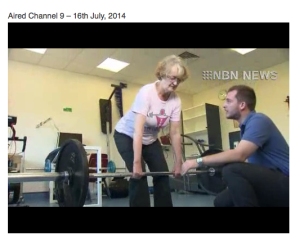
LIFTMOR Trial
“The participants were randomised to either 8 months of twice-weekly 30-min supervised HiPRT and impact loading or a low-intensity home-based exercise program of the same duration and dose. Testing at baseline and follow-up included bone, muscle, and fat mass testing and functional performance.”
Exercise guidelines typically recommend low to moderate intensity exercise to reduce the risk of fracture in adults with osteoporosis. There is very little evidence to support these recommendations. The group’s “goal was to examine the safety and efficacy of HiPRT and impact loading for risk factors of osteoporotic fracture in postmenopausal women with low to very low bone mass.”
28 women average age 68, with lumbar spine T-score -2.15 average have completed the study.
INTERVENTION GROUP EXERCISE PROGRAM: The intervention group activities included 2x-weekly, 30-min, supervised HiPRT and impact loading with 8 participants per session. Bodyweight and low-load exercise variants with a focus on controlled movement were undertaken for the initial 2-4 weeks of training to ensure that the participants were fully trained with correct lifting technique. The participants were trained to avoid loading the spine in a flexed posture. Loaded exercises were then introduced and intensity progressed, so that all participants were able to comfortably perform the 4 exercises of the program (deadlift, squat, jumping chin ups/drop landings, and overhead press) by the end of the second month. The three HiPRT exercises (deadlift, squat, and overhead press) were then performed in 5 sets of 5 repetitions for the remainder of the intervention, progressively increasing weight to maintain an intensity of 80−85% 1RM.
Impact loading was applied by jumping chin ups with drop landings. The participants started by reaching up to an overhead bar and gripping in an underhand, narrow grip chin up position. The participants then jump as high as possible while simultaneously pulling themselves towards or above the bar using their arms. At the height of the jump, the bar is released so that participants drop to the floor. 5 sets of 5 repetitions of the action were performed for the duration of the intervention. Progression of impact intensity was achieved by natural training-related increases in height of the jump and chin up, by raising the bar and by gradually increasing the intensity of the impact landing from a shock-absorbing flexed lower limb position to a more stiff-legged landing. The participants performed 2 sets of five deadlifts at 50−70 % 1RM to serve as a warm-up as required. All groups were fully supervised by an exercise scientist/physical therapist.
CONTROL GROUP EXERCISE PROGRAM: Control group activities for the 16 participants included a very low-load home-based exercise program primarily designed for the purposes of participant retention, with the potential to reduce risk of falling (the latter for ethical reasons to address a duty of care to individuals who may be at increased risk of fracture). The control group regimen was similarly comprised of two 30-min sessions per week, consisting of a 10-min walking warm-up, four stretches, and four low-resistance exercises (lunges, calf raises, standing forward raise, and shrugs), with a focus on flexibility, lower limb muscle endurance, and balance, followed by a 5-min warm-down walk. The intensity of the resistance exercises was mildly increased by progressively adding hand weights (to a maximum of 3 kg) and increasing repetitions.
RESULTS: The 12 participants that received HiPRT and impact loading showed improved height of 0.4 cm and improved femoral neck bone mineral density of 0.3%, and improved lumbar spine BMD of 1.6%. Functional performance improved in the INTERVENTION group in following areas of back extensor strength, gait speed, sit to stand leg strength, and balance as indicated by the functional reach test as compared to controls.
INTERVENTION GROUP vs. CONTROL GROUP RESULTS COMPARISON:
- Height: 0.4cm vs. -0.3cm
- Femoral Neck BMD: +0.3% vs. -2.5%
- Lumbar Spine BMD: +1.6% vs. -1.7%
- Back Extensor Strength: 65.7% vs. 17%
- Timed Up and Go Test (TUG): 2.6% vs. -3.3%
- 5 Times Sit to Stand: 6.2% vs. -1.6%
- Functional Reach Test: 7.9% vs. -1.3%
The 16 participants that received low-intensity exercise showed the following: Height loss of -0.3cm, femoral neck -2.5, lumbar spine BMD -1.7, and functional performance decline in gait speed, leg strength and functional reach. They improved 17% in back extensor strength.
There were no reported injuries.
Commentary: I think this is a greatly needed trial. I am thrilled to see that exercise may be proven to build bone mineral density without medication. However, I am concerned about the lifting technique (as seen in videos posted online- https://www.youtube.com/watch?v=9EZw_wrFnmI) that may predispose the participants to vertebral compression fractures. Outcome measures were taken via DXA and functional tests. I was pleased to see that they included standing height in the study outcome measures to monitor height loss due to vertebral compression fractures. I would have loved to see them include VFA, and Kyphotic Index pre- and post-trial to be sure that no participant had subsequent vertebral fractures during the study. I look forward to the results from the continuation of the study of the 354 subjects that will be entered into the trial!
http://www.ncbi.nlm.nih.gov/pubmed/26243363






 TheraPilates Blog